
Regolith and Dust simulants
We produce a comprehensive range of regolith and dust simulants, with a particular focus on Lunar and Martian materials. Our dusts are created using methodologies that replicate the mineralogical composition, geochemical environment, and unique space conditions under which planetary regoliths form.
Our Lunar simulants are exact textural replicas of real Lunar dusts. They are highly electrostatically charged, and chemically activated to contain Reactive Oxygen Species (ROS) and other radicals. They are 100% free of organics and fully sterile, which makes them ideal for astrobiological experiments.
In close collaboration with SolSys Mining, we increase the availability of specialty simulants tailored to every engineering or scientific need. From basic to ultra-high-fidelity simulants, we can provide solutions for any requirement.
Applications include:
-
- Mechanical wear testing of instruments, materials, specialty textiles for astronaut suits, optical devices etc.;
- Biotoxicity and Space agriculture experiments;
- Electrostatic and thermal testing of electronics;
- wear of optics;
- Dust mitigation experiments;
- Dust reactivity and oxidation experiments.
Example: Tribological damage (wear) of astronaut suit textiles
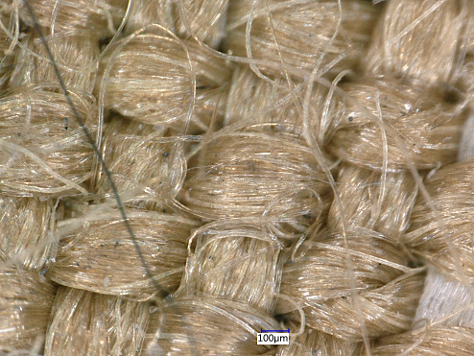
Optical microscopic image of an original, untreated Neoprene Vectran textile. This textile is considered as a durable material for astronaut suits.
The other side of the textile is covered with rubber.
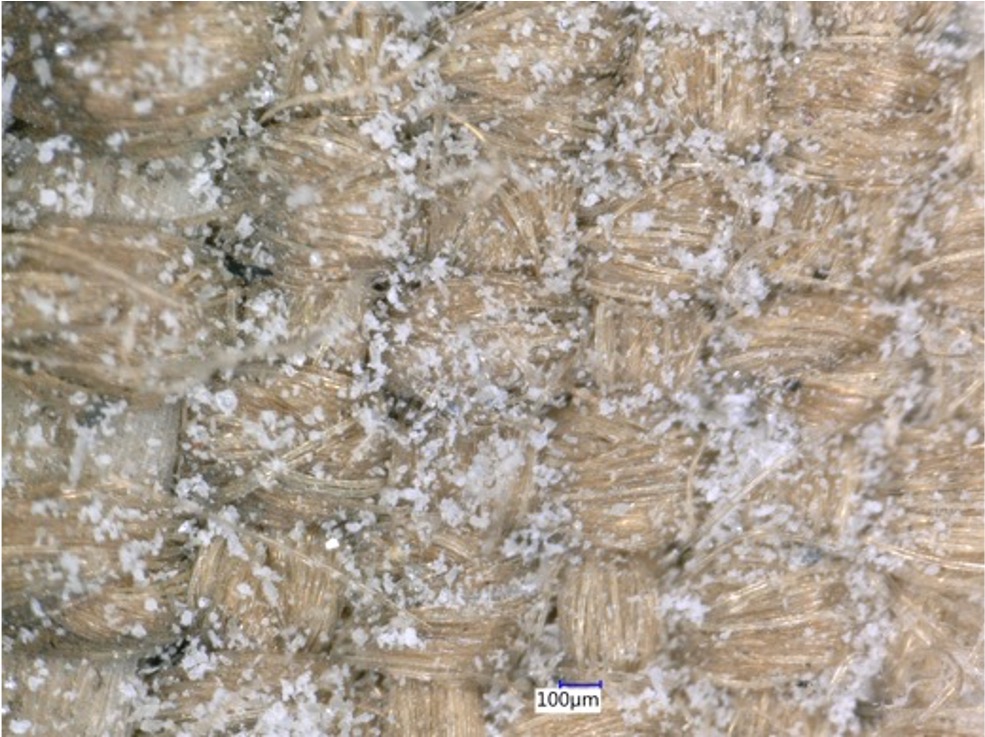
Optical microscopic image of the still untreated Neoprene Vectran textile, exposed to a deposit of our Lunar dust simulant (bright white sugar-like powder).
The dust grains are less than 100 μm in size, reaching down to 20 nm (yes, nanometers).
Dust is made of angular fragments, spheroid melts, and agglutinates of those, resembling exactly in texture the actual Lunar dust as we know it.
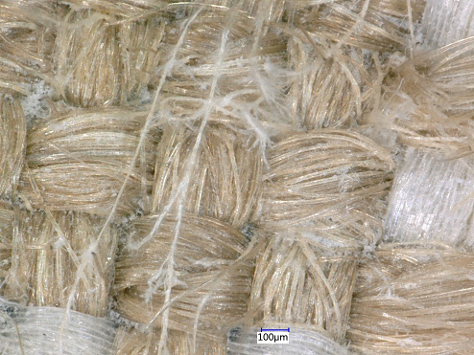
Optical microscopic image of a the now treated Neoprene Vectran textile.
Treatment involved 1000 rubbing cycles (about 10 minutes treatment) of one piece of textile on another without pressure, under vacuum conditions.
The wear of the fibers is profoundly visible. Also, it is clear that the dust intrudes the woven structure. Tests have shown that it reaches the other side, even if it is covered with rubber (no full isolation is ensured).